Apple Vision Pro
Apple's first new product category since Apple Watch (2015) — introduced personally by John Ternus at WWDC 2023. Spatial computing headset with M2 + R1 silicon, 23-million-pixel micro-OLED, and 600+ apps at the February 2024 launch.
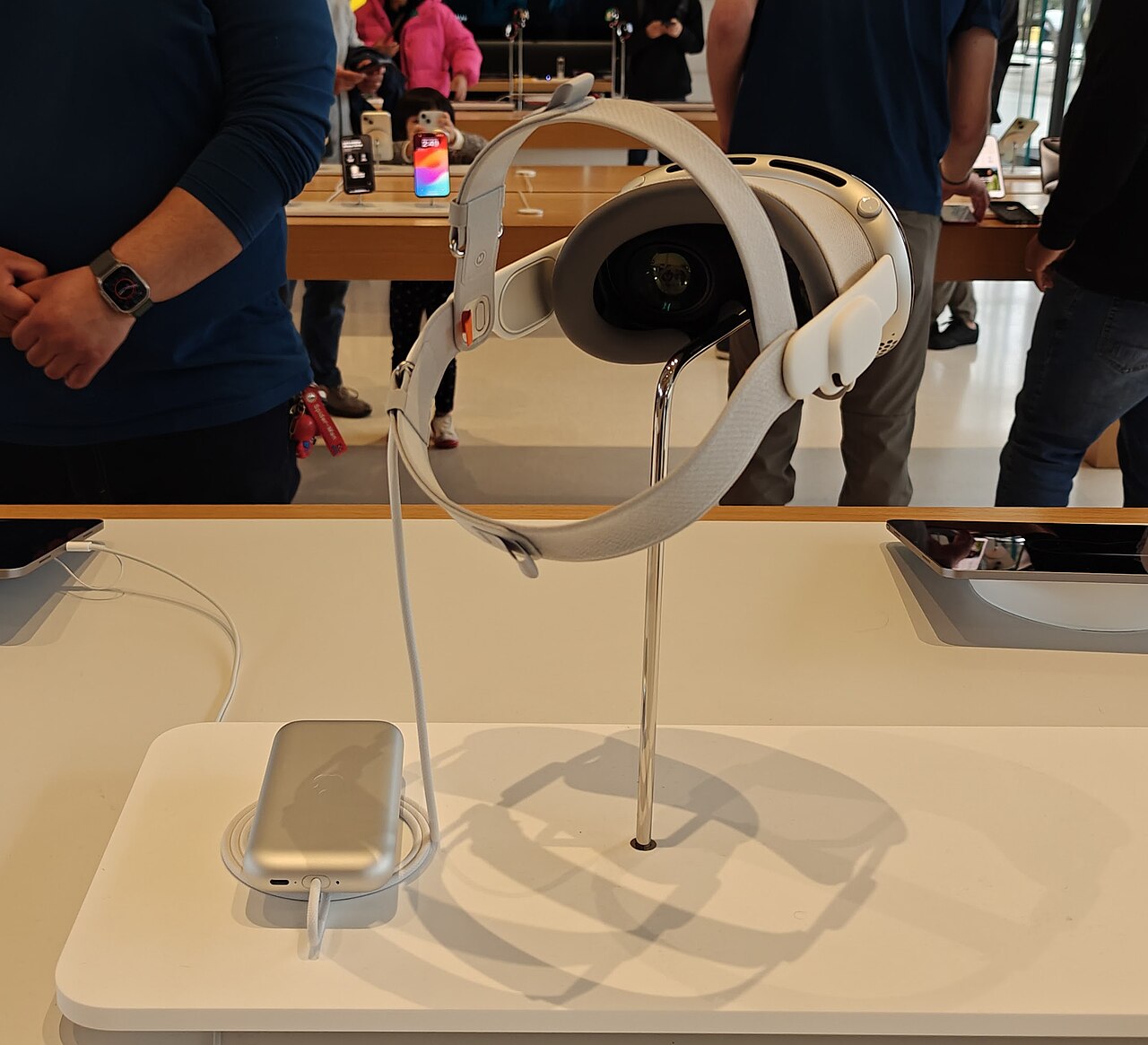
The Apple Vision Pro — announced at WWDC 2023, shipped on February 2, 2024 — is Apple’s first new-category product since Apple Watch (2015), and the first product entirely developed under John Ternus’s sole hardware leadership. Launch price: $3,499. Platform: visionOS (an iOS variant for spatial computing). Position in Apple history: the most ambitious hardware bet since the original iPhone.
This page is the product record, the launch context, and why the WWDC 2023 presentation was the clearest public signal that Ternus would be Apple’s next CEO.
The WWDC 2023 presentation
WWDC 2023 was different from the script: John Ternus took the stage alone to introduce Vision Pro. Not Tim Cook, not Craig Federighi (Federighi presented only visionOS, briefly, later). Ternus did twenty-one minutes of presentation alone — the longest solo technical segment of his career.
The choice was a signal. Apple does not put engineers alone on stage for tertiary products. When you put your SVP of Hardware Engineering on stage to introduce an entire new category, you’re saying two things:
- This is a serious product, with real technical decisions that deserve to be explained in detail, not a keynote-show.
- This executive is the face of the product. Anyone working with Vision Pro for the next ten years will report — directly or indirectly — to Ternus.
In retrospect, now that we know Ternus is the next CEO, the WWDC 2023 presentation reads as a public audition. Apple rarely auditions. When it does, it does so on the largest stage it has.
Hardware specifications
Apple Vision Pro is a mechanical and optical engineering product first, software second. The specs are deliberately out-of-category for any existing 2024 headset:
- Display: two micro-OLED panels, 23 million pixels total (more than two 4Ks). Pixel density approaching 4K-equivalent per eye.
- Chip: Apple M2 (general CPU/GPU) + Apple R1 (sensor and timing dedicated chip — cameras, IMU, eye-tracking). R1 is the first public appearance of an Apple chip dedicated to real-time sensor handling, with photon-to-display latency of 12 milliseconds.
- Sensors: 12 cameras, 5 sensors, 6 microphones. Includes LiDAR for 3D scene reconstruction.
- Audio: two drivers per ear with dynamic spatial audio, adjusted by ear geometry.
- Tracking: eyes (foveated rendering), hands (no external controllers), voice (Siri), and real-time environmental reconstruction.
- EyeSight: external display showing the user’s eyes to other people in the room. The product’s most controversial choice.
Each of those decisions individually is frontier engineering. Combined, they are integrated systems engineering at a scale that, outside Apple, no one was executing in 2024.
The category: spatial computing
Apple refused the terms “VR” and “AR” for Vision Pro. The official term is spatial computing. The word choice is deliberate — “VR” carries 2010s gaming-PC baggage, “AR” carries Pokémon Go baggage. Apple wanted to reposition Vision Pro as a computer, not a gaming peripheral or Snapchat accessory.
The thesis: just as the iPhone made it obvious phones needed full touchscreens, and Watch made it obvious computing on the wrist was a viable niche, Vision Pro would make it obvious that the next display surface is the user’s physical environment. Software windows floating in the room. A movie on a virtual 30-meter “screen.” FaceTime video at person-real-size in front of you.
In 2024, that thesis is still controversial. Initial sales were modest (estimates of 200K–500K units in the first year). But Apple did not position Vision Pro as a mass-market product in 2024 — it positioned it as a developer product, attracting the software-side ecosystem while hardware comes down in price across future iterations.
The EyeSight controversy
EyeSight — the external display that shows the user’s eyes through the headset — was Vision Pro’s most controversial product decision. Critics called it macabre, unnatural, hardware “uncanny valley.” Defenders called it the only socially acceptable solution to the “headsets make you look alien” problem.
The technical choice reflects a philosophical position from Ternus that resonates throughout the product: spatial computing is a social space, not an escape space. You don’t put on Vision Pro to escape your apartment; you put it on to work with more screen real estate while still being present for the people in the apartment. EyeSight is the hardware translation of that position.
Reception and impact
Apple Vision Pro received technically enthusiastic and commercially cautious reviews in 2024. The technical consensus: the best headset ever built. The commercial consensus: too expensive for the average consumer in 2024. Both true.
The cycle has begun. In 2025–26, Apple signaled work on a cheaper Vision variant (a “Vision Air”), and on a second Vision Pro generation with lighter components and longer battery life. Those products will ship under Ternus as CEO. The category Ternus introduced on stage in 2023 will be the category he expands as CEO from 2026 onward.
Why this matters for the CEO seat
Vision Pro is a product that can only be built by a company with:
- Hardware operations capability at scale (Apple Silicon, optics, manufacturing),
- Financial appetite for multi-year bets with delayed return ($10+ billion in R&D before the first product),
- Marketing willingness to defend a new category the market hasn’t asked for.
Cook had all three. Ternus, coming from hardware, brings the first more reinforced. See What does it mean to have a hardware CEO? for the structural analysis of what changes at Apple under Ternus, and the biography for how he got to the WWDC 2023 stage.
Specifications summary
- Chip: Apple M2 + Apple R1 (sensors).
- Display: two micro-OLED, 23 million pixels total, ~4K-equivalent per eye.
- Photon-to-display latency: 12 ms.
- Cameras: 12. Sensors: 5. Microphones: 6.
- Operating system: visionOS 1.0 (launch), 2.0+ later.
- Launch apps: 600+ native, 1 million+ via iPad compatibility.
- Launch price: $3,499 (256 GB).
- Initial availability: United States.
- Launch: February 2, 2024.
See also
- M-series (Apple Silicon) — the M2 chip inside Vision Pro.
- iPad Pro 2018 — Ternus’s first solo presentation.
- Biography — Ternus from Virtual Research Systems (VR in the 1990s) to Vision Pro (VR in 2024).
- Succession — how Vision Pro paved the road to the CEO seat.